
Continuous Heat Pump Operation Linked to Legacy Controls
i-HEATPUMP repairs result in up to 57% weather-adjusted energy reduction - that's £238 savings in March Vs January
System Profile
Location: Fife, Scotland
Equipment: Air Source Heat Pump
Application: Heating & Hot Water
Installation: 1-2 years old
SCOP (before): 2.72
Winter Fuel Cost: £600/month (1994 kWh)
Building Type: Detached House (3 Bed)
Construction Type: Mixed, Solid Stone + Timber Frame Construction
Complimentary Renewable Technologies: Solar PV + Battery Storage
Hydraulic Layout: Hot Water Cylinder (210L) + Integrated Buffer (50L) + 2-port valves
Heating Layout:
Zone 1 - Underfloor Heating + Radiators + Towel Warmers
Zone 2 - Radiators + Towel Warmers
Thermostats:
Zone 1 - Multi-room thermostats + radiator valves
Zone 2 - Wireless zone thermostat & receiver
Heat Pump Control Logic: Weather Compensation
Target Flow Temperatures: Cold Weather A-1,W60, Warm Weather A 15,W37
Our Role
i-HEATPUMP were initially appointed by the original installer in February 2026 to carry out the systems first annual service, investigate high running costs, and verify system performance.
Initial homeowner feedback indicated unusually high energy consumption for a relatively modern system. While the property is exposed and partially solid stone, ~£600/month was considered excessive.
The homeowners advised that although there was a third-party optimiser installed, this had been functionally disconnected - it had been unable to control the system effectively.
Verify
As with all in-depth diagnostics, we began with verification.
Installed Testo 115i temperature clamps on flow and return
Applied simultaneous demand across both heating zones
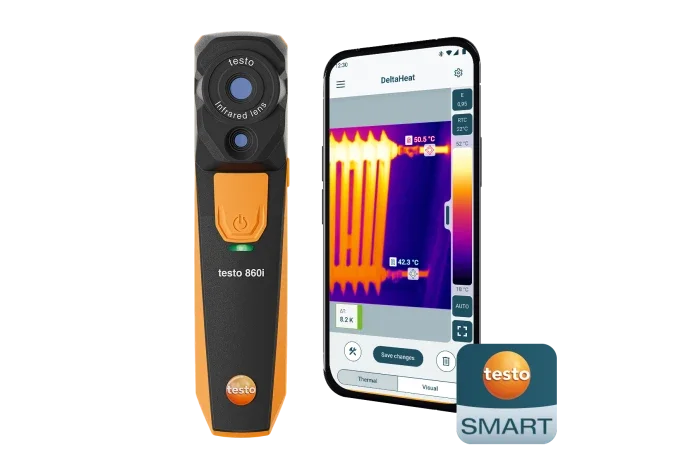
Conducted thermal imaging survey of building fabric with Testo 860i thermal imaging camera
Observed system behaviour through warm-up, steady-state operation, domestic hot water and heating demand satisfied operation
At steady state:
Flow rates and temperatures were stable
Heat delivery matched expected output
On the surface, the system appeared to be operating correctly when under heating and hot water demand.

Diagnose
The issue became apparent when demand was removed and the system was monitored.
With:
Both thermostats satisfied
Both 2-port valves closed
The heat pump continued to operate intermittently
We identified:
A permanent live heat demand signal was energising the system, independent of actual heating demand.
This originated from:
A legacy wiring centre predating the heat pump installation
Wired in a manner similar to S-plan, but with multiple 240 V supply sources and control conflicts
Resulting behaviour:
Heat pump ran with no active load
Heated water circulated between heat pump & buffer tank
Repeated low-load cycling
Continuous parasitic heat loss
The system was producing heat and then wasting energy by circulating the heat between the heat pump outdoors and the buffer volume indoors. Understandably, the homeowners reaction during the height of winter was to turn the the thermostats to a lower set point; however, this wouldn’t have solved the problem as the heat pump controller was receiving a permanent call for heat.
Fix
We:
Traced and isolated the erroneous permanent live signal
Reduced target flow temperatures
Reconfigured the control logic to ensure:
Heat demand only present when zones call
Proper valve interlocking
Correct heat pump enable signal
Serviced the full heating system & applied corrosion protection treatment
Post-correction:
Heat pump operation aligned strictly with real demand
Unnecessary cycling eliminated
Buffer circulation only occurred under load
Learn
The adjustment works were completed on the 20th February - the manufacturer’s on-board energy monitor recorded the following pre / post improvement work heat pump energy consumption values:

Chart - onboard monitoring energy consumption Jan-March 2026. Cost assumes 30p/kWh.
Following diagnosis and correction of the control fault, total energy consumption reduced significantly (-70% March Vs Jan).
At face value, this looks to be a dramatic improvement - it is, but it’s important to separate:
What changed because of warmer weather, and
What changed because the system was fixed
To do this, we allow for weather using heating degree days (a standard method for comparing heating demand across different months).
After weather adjustment = 57% reduction in energy consumption
What does that mean?
Equivalent to around £238 savings in March versus January, the cost of i-HEATPUMP repairs are quickly recovered.
Typical monitored heat pump systems over the same period show around:
30–38% reduction raw energy consumption reduction January Vs March
This is the normal seasonal effect as temperatures rise. In this case:
The system energy consumption reduced by ~70% overall achieving ~57% reduction after allowing for warmer weather.
Some energy savings will be due to user behaviour & heating demand; however, even allowing for these, the results indicate a substantial improvement beyond normal seasonal variation - the majority of energy savings can be attributed to i-HEATPUMP performance mprovements.
Does this mean every system can be improved by a similar margin?
No. i-HEATPUMP’s approach will identify control issues and opportunities to:
improve efficiency
reduce running costs
improve comfort / cost balance
In most scenarios this will result in reduced running costs but the severity of savings is dependent on the severity of the problems.
Further Improvement
i-HEATPUMP support doesn’t need to stop after initial rectification works. The homeowners are keen to explore further improvements that can be made before the next winter heating season.
Options that they can explore that fall outside the original scope of works include:
further reduction in weather compensation target flow temperatures
removal of some or all under floor heating actuators & replacement with manual balancing control
replacement of multi-room wall thermostats (zone 1) with a single wireless thermostat
heating system flush
smart energy tariff
adjustment to battery charge regime
adjustment of hot water scheduling & target temperature
solar pv panel cleaning
Heat pump costing you a fortune to run?
Book an appointment for a day and time that suits you.
Alternatively, if you would like to speak with a heat pump specialist ahead of booking an appointment, please complete the call back request form below:
Case Study Resources
Sensitivity Analysis
| Scenario | January HDD error | March HDD error | Resulting saving | Comment |
|---|---|---|---|---|
| Baseline | 0.0% | 0.0% | 57.2% | Reference case |
| +5% favourable | -5.0% | 5.0% | 61.3% | January lower / March higher |
| +5% adverse | 5.0% | -5.0% | 52.7% | January higher / March lower |
| +10% favourable | -10.0% | 10.0% | 65.0% | January lower / March higher |
| +10% adverse | 10.0% | -10.0% | 47.7% | January higher / March lower |
| +15% favourable | -15.0% | 15.0% | 68.4% | January lower / March higher |
| +15% adverse | 15.0% | -15.0% | 42.1% | January higher / March lower |
Methodology
Heating Degree Day Analysis
Heating systems use more energy when it is colder outside. Heating Degree Days (HDD) are a simple way to measure how cold the weather was during a period.
By adjusting energy use using HDD, we can compare months more fairly, even if one month was colder than another.
This analysis uses a 15.5°C base temperature, daily actual high/low values, and a simple daily mean approximation:
Daily mean temperature = (Actual high + Actual low) / 2
Daily HDD = MAX(0, 15.5 − Daily mean)
Main calculations
Monthly HDD = sum of daily HDD values in that month
kWh/HDD = monthly controller kWh ÷ monthly HDD
Weather-adjusted saving % = 1 − (post kWh/HDD ÷ baseline kWh/HDD)
January is treated as the baseline, March as the post-adjustment period, and February is retained only as transitional context due to partial system downtime.